N|Solid Downloads Surged 98% in August 2026 — What It Says About Node.js Runtime Adoption

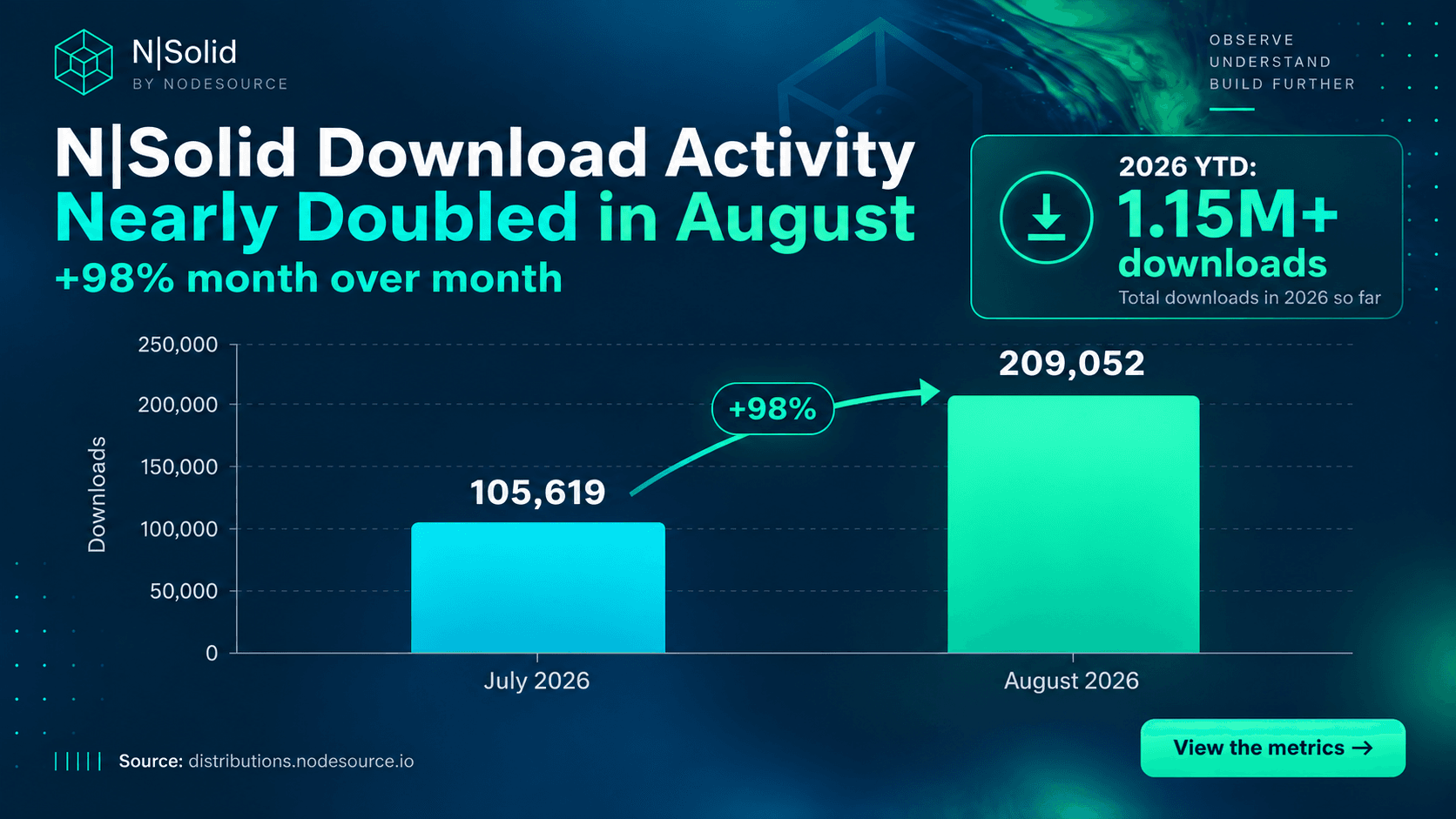
N|Solid Runtime has been downloaded more than 1.15 million times in 2026, bringing total downloads to more than 2.4 million. In August alone, download activity increased from 105,619 to 209,052, a 98% month-over-month increase.
The growth is notable, but the more useful signal is what sits underneath it: how Node.js runtimes are being pulled across development and production infrastructure, which versions are gaining ground, and which older generations remain active long after newer releases become available.
Want to try N|Solid? N|Solid Runtime is an open-source, cross-platform JavaScript runtime based on Node.js, with performance, security, and diagnostic visibility built directly into the runtime.

N|Solid Download Activity Nearly Doubled in August
N|Solid download activity has continued to grow throughout 2026, with August showing a significant jump:
- July 2026: 105,619 downloads
- August 2026: 209,052 downloads
- Month-over-month growth: ~98%
- 2026 YTD: 1.15M+ downloads
- All-time: 2.4M+ downloads
The cumulative number gives us a sense of scale. The month-over-month change tells us something different: N|Solid is being pulled more frequently across the systems that build, provision, and run Node.js applications.
Those downloads can come from developer machines, containers, CI/CD pipelines, automated builds, cloud infrastructure, and other environments where runtimes are installed or provisioned.
That is also why we treat downloads as a measure of runtime activity, rather than a direct count of users or applications.
Explore the N|Solid distribution metrics →
What N|Solid Adds to Node.js
N|Solid is built on Node.js, but adds observability directly at the runtime layer.
That allows engineering teams to capture performance, security, and diagnostic information from inside the Node.js process, including CPU and memory behavior, event loop activity, CPU profiles, heap snapshots, application performance signals, and package and security intelligence.
The distinction matters because some of the most useful information about a Node.js application originates inside the runtime itself.
Instead of treating Node.js as a black box beneath the application, N|Solid exposes runtime evidence that developers and operations teams can use to investigate why an application is consuming resources, slowing down, or behaving unexpectedly.
N|Solid Runtime can be used independently and also provides the runtime intelligence behind NodeSource tooling such as N|Solid Console, the N|Solid Extension for code editors, and the N|Solid Plugin for AI coding agents.
The Version Mix Tells a Bigger Story
The broader Node.js ecosystem has also been moving quickly in 2026.
Official Node.js distribution data recorded 4.61 billion downloads through July, already exceeding the total recorded during all of 2025. Node.js 24 also became the most downloaded major release in July.
But newer releases gaining traction does not mean older runtimes disappear immediately.
Node.js 20 still recorded more than 103 million downloads in July, despite reaching End-of-Life on April 30, 2026. Node.js 18, which reached EOL a year earlier, continued to appear in tens of millions of downloads.
N|Solid distribution data reflects the same broader reality: runtime modernization happens gradually. Supported releases gain adoption while older Node.js generations remain embedded in applications, containers, build systems, and deployment infrastructure.
For engineering teams, that version mix is more than an adoption trend.
Once a Node.js release reaches EOL, continuing to run it can introduce increasing security, compatibility, maintenance, and operational risk as the ecosystem around the application continues to move forward.
Downloads Measure Activity, Not Users
A runtime download does not equal one developer, one production server, or one application.
The same package may be pulled repeatedly by Docker builds, ephemeral CI environments, version managers, automated provisioning, or local development workflows.
That makes individual download counts unsuitable as a user metric, but the trends are still useful.
Over time, distribution data can show how runtime activity changes, how quickly newer Node.js releases enter infrastructure, and how long legacy versions continue to persist.
With Node.js 24 adoption growing and Node.js 26 approaching LTS, that transition is worth watching closely throughout the rest of 2026.
Better Runtime Data Leads to Better Decisions
Knowing which Node.js version an application runs is only one part of understanding its production behavior.
Teams also need to know where CPU time is being spent, how memory behaves under load, whether the event loop is becoming constrained, what dependencies introduce risk, and what changes when the underlying runtime moves to a newer release.
N|Solid is designed to expose that layer.
The growth we're seeing in 2026 is encouraging, but the more interesting outcome is the visibility the distribution data provides into how Node.js itself moves through real infrastructure.
Explore N|Solid Runtime on GitHub →
View N|Solid download trends →
Running an EOL Version of Node.js?
An unsupported runtime may continue working today while security, dependency compatibility, and operational risk accumulate around it.
Understand your application's upgrade risk and build a clear path to a supported Node.js release with the NodeSource Upgrade Program.