NodeSource Weekly — Sept 15, 2026: Node.js 24.21.0, N|Solid Growth & AI Agents

👋 Welcome to This Week’s Edition!
Here’s what’s inside:
🟢 Node.js Releases: What’s new in Node.js 24.21.0 LTS and Node.js 26.8.2 Current, including updates across OpenSSL, Undici, performance, and runtime maintenance.
📈 N|Solid Growth: N|Solid downloads surged 98% in August, DevTools passed 2.5K downloads, and N|Solid reached 1.15M downloads in 2026.
🌎 Community & Events: Highlights from ParaíbaJS 2026 and a look ahead to NodeConf EU, where Rafael Gonzaga will represent NodeSource.
🤖 AI Corner: New developments around AI agents, the Agents API, and practical guidance for building safer MCP tools in Node.js.
🚀 Node.js Upgrade Program: Resources and expert support for teams moving from End-of-Life Node.js versions to supported releases.
Happy reading! 🚀
🟢 Last Week in Node.js
Last week brought new releases across both the LTS and Current release lines, with updates focused on security dependencies, networking performance, diagnostics, and runtime maintenance.
Node.js 24.21.0 (LTS) — Krypton
Node.js 24.21.0 landed with several notable improvements across cryptography, networking, and performance tooling.
- 🔐 OpenSSL updated to 3.5.8, alongside updated root certificates from NSS 3.126.
- 🌐 Undici updated to 7.29.1, bringing the latest improvements to Node.js' HTTP client stack.
- ⚡
net.BlockListperformance improvements make IP and network filtering more efficient. - 📊 Histogram tooling gets smarter, including improved implementation and statistical hypothesis testing in
perf_hooks. - 🔑 Crypto now supports loading private keys through OpenSSL STORE loaders, expanding key-loading options.
- 🧩
MIMEType.parse()gains a non-throwing parsing option, making MIME type validation easier to handle in application code.
The release also includes fixes and performance improvements across HTTP, file system operations, DNS, ESM, and diagnostics.
Node.js 26.8.2 (Current)
Node.js 26.8.2 continues stabilizing the Current release line with dependency updates and runtime maintenance ahead of the Node.js 26 LTS transition.
- 🔐 OpenSSL updated to 3.5.8.
- 🌐 Undici updated to 8.10.2.
- 📦 npm updated to 11.19.1 and Corepack to 0.36.0.
- 🛡️ The project refined its security vulnerability posture for experimental features, clarifying how security issues affecting experimental APIs are handled.
- ⚠️
Server.prototype._listen2innode:netis now deprecated, further discouraging reliance on an internal API.
The release also includes build improvements for Windows and RISC-V, documentation updates, and reliability fixes across Node.js' test infrastructure.
🚀 Featured from NodeSource
📈 N|Solid Downloads Surged 98% in August
N|Solid downloads nearly doubled in August, growing from 105K+ downloads in July to 209K+ in August.
N|Solid is NodeSource’s enterprise Node.js runtime, built to give teams deeper visibility into application performance, security, and production diagnostics.
The jump is more than a monthly spike. It reflects growing adoption of production-grade Node.js tooling as teams look for better performance visibility, diagnostics, and runtime control.
In our latest analysis, we break down the numbers, the versions developers are running, and what the data tells us about Node.js runtime adoption in 2026.
🧩 N|Solid DevTools Reaches 2.5K+ Downloads
The N|Solid Extension for code editors has now passed 2.5K downloads, another milestone for our developer tooling ecosystem.
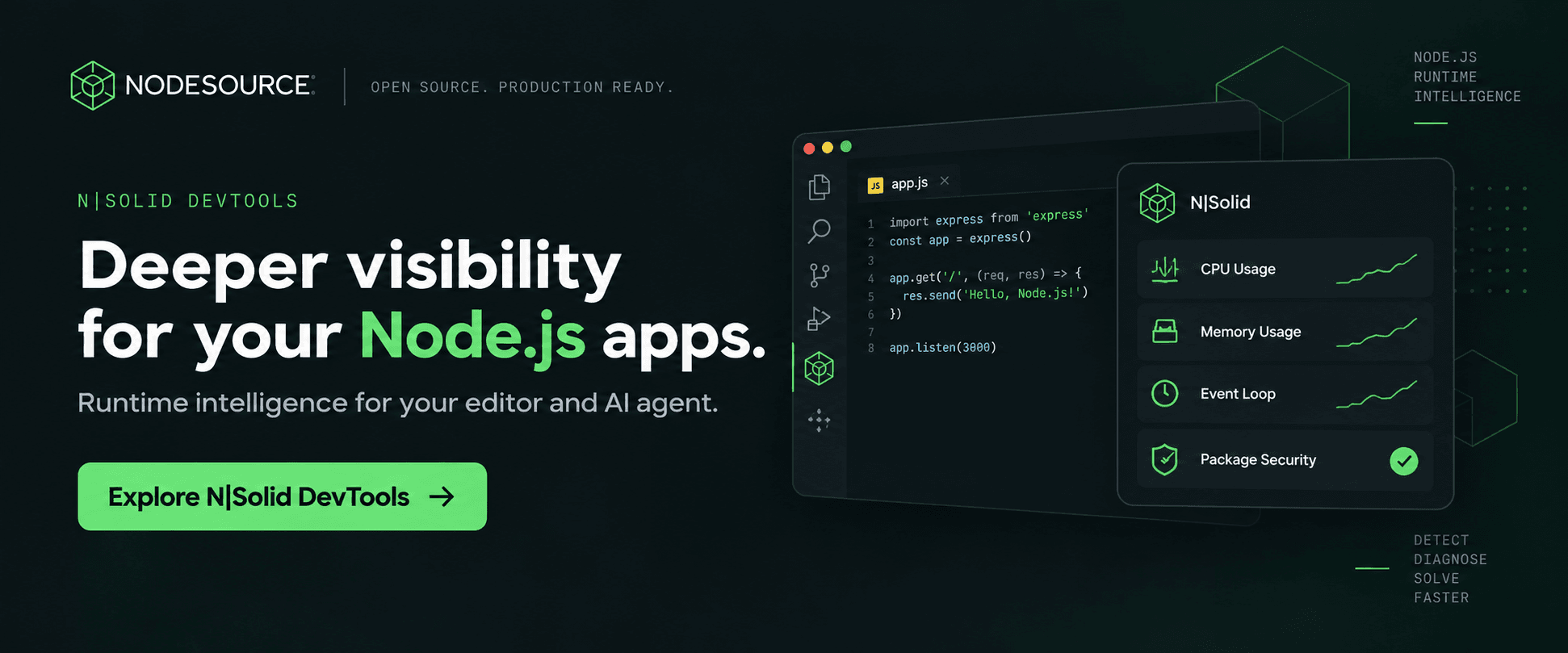
N|Solid DevTools brings runtime diagnostics closer to where developers already work, making it easier to inspect CPU, memory, event loop activity, package security, and application behavior directly from the development workflow.
Whether you're working in VS Code, Windsurf, or alongside AI coding agents, the goal is the same: make Node.js diagnostics easier to access before issues reach production.
🚀 N|Solid Reaches 1.15M Downloads in 2026
N|Solid has now been downloaded more than 1.15 million times in 2026, bringing total downloads to 2.4M+.
Built on Node.js, N|Solid adds enterprise-grade observability, performance monitoring, diagnostics, and security capabilities for teams running Node.js applications in production.
The milestone reflects increasing adoption of tooling designed to help engineering teams understand what is happening inside their Node.js applications and troubleshoot issues faster.
🌎 Community & Events
🇧🇷 NodeSource at ParaíbaJS 2026
This past weekend, Rafael Gonzaga, Principal Open Source Engineer at NodeSource and Node.js TSC member, joined the community at ParaíbaJS in João Pessoa, Brazil.
Rafael took the stage with “5 Ways You Could Have Hacked Node.js,” sharing lessons from real vulnerabilities fixed in Node.js and a behind-the-scenes look at security inside the runtime.
👉 See the highlights from ParaíbaJS
🇮🇹 Next Stop: NodeConf EU 2026
Rafael will also represent NodeSource at NodeConf EU 2026, happening September 29–30 in Bologna, Italy.
Alongside Antoine du Hamel, he’ll present “The New Node.js Release Model: Why Node 27 Changes Everything,” exploring why the Node.js release process is changing and what the new model means for maintainers, companies, contributors, and developers across the ecosystem.
🤖 AI Corner
-
🧠 OpenAI introduced the Agents API in public beta, bringing the infrastructure behind Codex to developers for building long-running agents with tool use, subagents, persistent context, and sandboxed environments.
-
🔌 Building MCP tools in Node.js? Keep the tool surface small. Give agents only the tools and permissions they actually need, validate inputs, keep authorization outside the model, and treat external content as untrusted. A recent SitePoint guide has a solid overview of production-ready MCP patterns.
👉 Read: Building AI Agents That Can Safely Work With Live Web Data Using MCP
🚀 Node.js Upgrade Program
Free Expert Help for Your Next Node.js Upgrade
Still running an End-of-Life version of Node.js?
The Node.js Upgrade Program, developed in partnership with the OpenJS Foundation, helps organizations migrate to supported LTS releases with free expert guidance from the Node.js ecosystem.
You can follow the step-by-step upgrade process yourself using the program's resources, or request assistance from the Upgrade Program team to help plan and execute your migration.
The program is designed to help organizations:
- ✅ Upgrade from End-of-Life Node.js versions
- ✅ Reduce security and compliance risks
- ✅ Plan migrations with confidence
- ✅ Modernize production applications
Participation is completely free for organizations.
⚡ Stay Connected
The Node.js ecosystem never stands still—and neither do we.
Subscribe to stay up to date with future editions featuring the latest Node.js releases, AI-powered developer tools, observability, security, and community news.
Have questions, feedback, or ideas for a future edition? We'd love to hear from you.
📩 Contact NodeSource
📧 teffcode@nodesource.com
See you next month! 👋